|
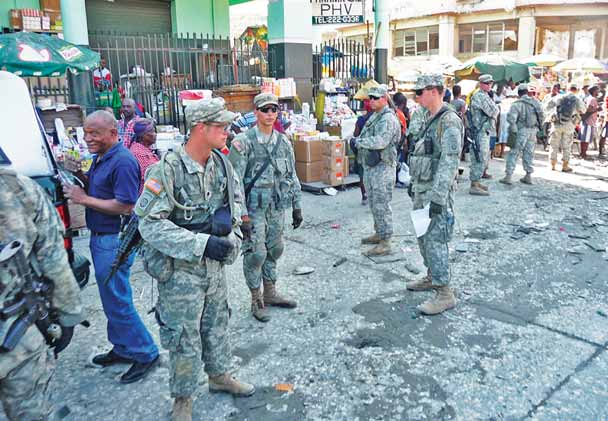
Troops from the U.S. Army’s 82nd Airborne division on Port-au-Prince’s main drag, Grande Rue (Avenue Jean-
Jacques Dessalines) on Feb. 20. “We are not at war. Why all the big guns?” asked one Haitain
The three U.S. soldiers parked
their tan Humvee on the sidewalk
across from St. Louis de Gonzague,
once Haiti’s most prestigious
high school. Today it is home to a
camp of about 6,000 displaced Haitians
still living in tents and tarpaulin
lean-tos six weeks after the Jan.
12, 2010 earthquake.
On the fence surrounding
the school, hundreds of paintings
are mounted for sale. The site is
well chosen. Delmas 33 is a back
route used everyday by thousands
of soldiers and so-called “non-governmental
organization” employees
(most are working for or with some
government) to go to and from
the airport where both U.S. and
U.N. troops are based. It is also the
command center for almost all the
NGOs.
The soldiers pensively perused
the paintings. Many depicted colorful
scenes of green hills, fantastic
animals, fruit trees, and quaint
houses which contrasted sharply
with the dust and devastation of the
outdoor gallery. Not far away on a
white wall was spray-painted in red
and Kreyòl: “Haiti Will Not Die!
Down with Occupation! Down with
the NGOs!” Solemn groups of young
men and market women – arms
folded, hands on chins – watched
the soldiers as they shopped. The
soldiers appeared oblivious to the
graffi ti, those watching them, the
history of the school, and the misery
of the camp behind the paintings.
They were tourists.
That’s the most charitable perception
of the U.S., French, Canadian,
and U.N. troops seen patrolling
everywhere but doing nothing
to help Port-au-Prince residents dig
out from under the rubble, which is
all that remains of much of the city.
Most Haitians harbor a deep resentment
of the foreign troops and want
them out of the country.
“We are not at war,” said
Paul Vilmé, 43, a now out-of-work
teacher and actor on Grande Rue
on Feb. 23 where that day U.S.
soldiers had fi nally helped clear
some quake debris “Why all the big
guns? Why all the big tanks? Are
they just showing off or are they up
to something? We need engineers,
architects, equipment operators,
people with shovels not M-16s.”
Not far away was Renold
Etienne, 32. He is in fact a heavy
equipment operator, who knows
backhoes, bulldozers, you name
it. He just spent three years in the
Bahamas and one year in Providenciales.
He had come back home
to visit his family for the holidays.
“The earthquake caught me here,”
he said.
Unable to return to Provo, he
has been to dozens of work sites,
stood for days outside the base of
the UN Mission to Stabilize Haiti
(MINUSTAH), and pleaded for a
job with many Haitian government
foremen. “They want references,”
he says with a shrug and a
mirthless laugh. “I’m living under
the stars, with just the clothes on
my back, with no home, having
worked overseas for the last four
years, and they want references?
Can you imagine such madness?
Anywhere else they would check
you out, see if you can operate the
rig, then set you to work, but not
here.”
Indeed, in a heavy equipment
rental house on the airport road,
at least ten backhoes and bulldozers
sit idly in the lot. The government
should be requisitioning such
equipment, one thinks looking at
it. Instead, such rental houses – for
equipment and cars – are raking in
money and are poised to rake in
more during this “reconstruction”
period, making Haiti’s rich bourgeoisie
even richer. (“Avis: Choice
of the NGOs!” heralds one billboard
by the airport’s MINUSTAH base). |

