|
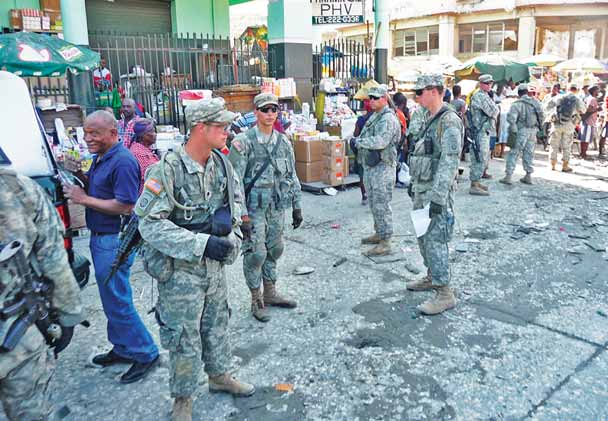
Troops from the U.S. Army’s 82nd Airborne division on Port-au-Prince’s main drag, Grande Rue (Avenue Jean-
Jacques Dessalines) on Feb. 20. “We are not at war. Why all the big guns?” asked one Haitain
Suddenly, the scavengers
were scattering. Men in yellow
TELECO jump-suits were chasing
them with clubs, whips, and guns.
“We’re clearing them off the site for
safety,” said one of the jump-suits.
“We don’t want anyone hurt by the
machinery.”
But the scavengers claim that
the jump-suits just want to monopolize
the copper wire for themselves.
“There is no work, we have
no other way to survive,” said one
of the young men, regularly glancing
over his shoulder to make sure
he would not be hit again. “Why
can’t they let us look for a little life
here? They are a bunch of scoundrels.
Look at them.” The yellow
suited men were picking up large
coils of wire and loading them into
a blue pick-up.
Excavation of the schools
is an even grimmer affair. Last
weekend, trucks cleared the school
that collapsed behind St. Gérard’s
Church in Carrefour Feuilles. In the
ruins were the bodies of 40 young
students and a few teachers. All the
cadavers were dumped in two mass
graves at the bottom of the hill behind
the church, just feet from the
road.
“One of the graves has been
closed, the other hasn’t,” said
Stanley Tingue, 14, who escaped
death on Jan. 12 because he left the
school early to go to the bathroom
in the church next door. The stench
of death coming from the open pit
is overpowering, causing one to immediately
gag. “They are still putting
bodies in that one. Two hundred
students died at St. Gerard
University, which they are clearing
down there. They have buried most
of the boys. Now they are doing the
girls.” He points to an excavation
site where a few trucks and backhoes
sit idle, immediately across
the street from the mass graves.
It
is Sunday.
Stanley displays a strangely
vacant sadness, speaking with a
matter-of-fact air. “Down there, by
those plastic jugs, there are lots of
body parts,” he says almost listlessly.
“You will fi nd hands and
feet.”
He has come by the empty
space that was his former school
this Sunday just to look around.
One wonders what kind of psychological
scars he has after watching
most of his schoolmates perish.
(To be continued) |

