|
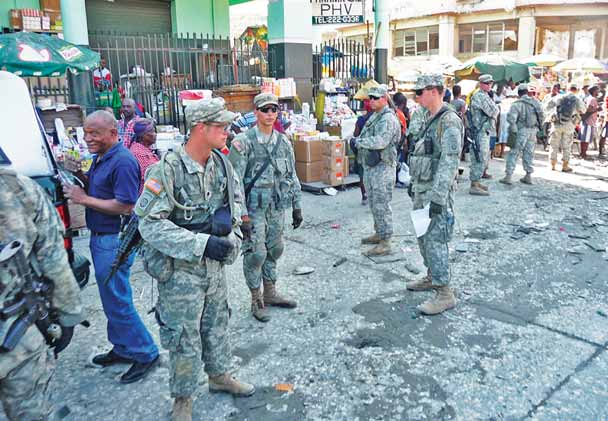
Troops from the U.S. Army’s 82nd Airborne division on Port-au-Prince’s main drag, Grande Rue (Avenue Jean-
Jacques Dessalines) on Feb. 20. “We are not at war. Why all the big guns?” asked one Haitain
Nonetheless, President René
Préval has deployed his specially
created National Center for Equipment
(CNE) – which boasts dozens
of dump trucks and excavation
equipment – to raze dozens of sites
around the capital: the Women’s
Ministry off Champ de Mars, the
TELECO building on Grande Rue,
CANADO School in Turgeau, the
Lycée Pétion behind the Cathedral’s
ruins, and La Source School
near Sacré Coeur’s ruins are just a
few. The government is concentrating
on schools and public buildings
fi rst, then it will set about leveling
the ruins of private homes and businesses,
a government insider says.
Spray-painted in red on hundreds
of buildings are the words: “To Demolish.”
“That’s all I see the government
doing: carting away collapsed
buildings,” said Erol Monestime,
26, an unemployed plumber.
“That’s fi ne but what about us, the
people. They take no leadership on
that front, leaving us to the mercy
of a bunch of incompetent and corrupt
NGOs.”
This is the biggest complaint
from people all over the capital. “I
have no tent, no tarpaulin, no food,
no water, no coupons, no aid period,”
complained Lamercie Lounes,
28, echoing the words of many others
interviewed. “The guys who get
the food coupons give them to their
friends, or to women who sleep
with them, or they sell them. It is
corrupt. You have to know someone
to get aid. It is a business.”
NGOs implemented a system
of food coupons. The coupons are
given to local “leaders,” who are
supposed to distribute them equitably
in their communities. Only
women are allowed to pick up a
bag of rice with the coupons at the
food distribution centers. For other
necessities, like cooking fuel, water
and beans, Haitians are left to their
own devices.
“I lost my wife and mother in
the earthquake,” said Johnson Dejoie,
39. “I have no job and no way
to get any rice. If it wasn’t for the
generosity of neighbors, I wouldn’t
be alive now.”
The NGO’s food distribution
program is ending now anyway.
The Haitian government has said
that it will continue to feed 300,000
in Port-au-Prince, but people on the
street don’t believe them and don’t
know how it will work.
One sees people scrounging,
scavenging everywhere. Almost
every collapsed building has iron
rebar sprouting out of it like wild
strands of hair. Often in front of a
ruin there is a giant, dense tangle of
it, like some piece of abstract art. On
the ruins, men with hacksaws and
sledge-hammers doggedly work,
sweating under the blazing sun and
breathing in the choking white dust
and exhaust fumes that makes up
most of downtown’s atmosphere.
“I’m going to use it for solder,
or maybe make a table out of
it, or maybe sell it,” said one old
man painfully dragging four long,
twisted rebar rods behind him down
the street. “I’ve got to do something
with it,” he said with a big toothless
smile.
Dozens of young men
swarmed over the site where Grande
Rue’s TELECO building was being
razed last week. Some were working
on rebar, but others were making
piles of aluminum. It sells for 7
gourdes a pound, about 17 cents a
pound. Some tore out circuit boards
from smashed, ancient computers.
Still others were after the big prize:
copper wire, which sells for up to
35 gourdes or 87 cents a pound,
they said. |

