|
 The two leading candidates in
the upcoming Dominican Republic presidential elections
differ little when it comes to economic policy and the
targeting of migrant and migrant-descendant communities. In the Dominican Republic, as in
many other countries around the Caribbean, the political
strategy of leading dominant groups in recent decades
has been one of polyarchy, where voters in democratic
elections have been limited to selecting between
different factions of elites.
Since the 1970s, U.S. foreign policymakers, along
with an increasingly wide array of UN, EU and other
international agency officials, have come to promote
this approach. If ideological differences can be
minimized, with parties differing little on core issues
like economic development, then electoral competition is
not only unthreatening to dominant interests but also
legitimating to notions of democracy.
This
scenario is on clear
display in the Dominican Republic, where the country’s
mainstream political parties, although squabbling, have
sought to further facilitate and benefit from this “new
normal.” The upcoming May 15 general election pits the
country’s two mainstream parties, the Dominican
Liberation Party (Partido
de la Liberación Dominicana, PLD) and the Modern
Revolutionary Party (Partido
Revolucionario Moderno or PRM), amidst a variety of
other parties.
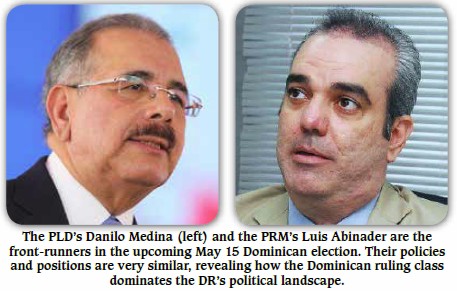
The incumbent candidate and leader in the polls
is Danilo Medina of the PLD. His main opponent is Luis
Abinader of the PRM. Medina’s tenure in office has been
marked by a deepening of the country’s integration with
the global economy and a controversial
“denationalization”
program targeting Haitian
migrant families and laborers, and the
descendants of Haitian migrants.
Abinader’s major campaign platform has been
centered on criticizing the Medina administration’s
corruption. But the policies of these candidates differ
very little and reflect the processes of polyarchy that
have taken hold in this country through recent decades.
Both candidates are backed by major business interests
(such as
CONEP
— the National
Council for Private Enterprise) and are calling to
intensify the repression of Haitian migrant labor.
Electoral politics have become shackled to the interests
of leading dominant groups, who look to use elections in
order to maintain the country as a spigot for global
capitalist accumulation.
The Making of Polyarchy in the DR
The Dominican Republic has been
challenged by decades of dictatorship, outside
intervention, and neoliberal cronyism. After over 30
years of dictatorship under Rafael Trujillo (1930-1961),
Juan Bosch became the Dominican Republic’s first
democratically elected president in 1963. Just seven
months later, however, right-wing putschists overthrew
him.
Faced
with a revolt from below, the putschists were kept in
power through a
U.S. military intervention
in 1965, which in turn led to the regime of President
Joaquin Balaguer, a political protégée of the former
dictator Trujillo.
Ultimately, a democratic opening occurred in the
late 1970s when the Dominican Revolutionary Party
(Partido Revolucionario Dominicano, PRD), originally
founded in part by Bosch in 1939, came into office.
Since then, the PRD has traded positions with the PLD,
and briefly, the Social Christian Reform Party (Partido
Reformista Social Cristiano, PRSC) – the party
associated with Balaguer. Over the last decade the PLD
has become largely dominant, while the PRD (or at least
amalgamations of it) has come to represent the Dominican
Republic’s main official opposition.
Up until the late 1990s, some progressive figures
like
José Peña Gómez
remained within the PRD even as it became increasingly
neoliberal, but during the early 2000s the PRD abandoned
its shrinking progressive wing. Dominican President
Hipólito Mejía of the PRD (2000- 2004) supported the
invasion and occupation of Iraq, even sending a military
contingent of several hundred troops, under the command
of Spanish foreign legion officers. (Mejia briskly
withdrew the Dominican military contingent when it
started incurring casualties.)
Under pressure from Haitian industrialists, Mejía
also allowed factions of his military and foreign
ministry to
shelter and provide safe
passage to neo-Duvalierist and ex-Haitian
army groups running cross-border
hit and run attacks
on Haiti aimed at ousting then President Jean-Bertrand
Aristide’s second popularly elected administration in
Port-au-Prince. The Organization of American States
(OAS) failed to even investigate the bloody assaults,
which are now well documented through
declassified U.S. Embassy
cables.
The PLD returned to office in 2006, and the
country continued to deepen its insertion into the
global economy, so that now the Dominican economy has
become inseparable from transnational capitalist
networks. The institutionally corrupt PLD, first under
President Leonel Fernández (1996-2000, 2004-2012) and
then under current President Danilo Medina
(2012-present), has cemented itself as the Dominican
Republic’s ruling political force through a well-oiled
electoral machine backed by large swaths of the
country’s top business community. PLD leaders have
positioned themselves to become part of what some
Dominican radicals describe as a “partidocracia”
(Partocracy) — a form of highly factionalized government
where one or a few parties control the political
landscape.
Both leading parties have codified their relationships
with transnational capital through the
DR-CAFTA supranational economic
forum.
The DR is currently the largest recipient of
foreign direct investment (FDI) in the history of the
Caribbean basin. Most important for this growth in FDI
has been the transnational mining corporation
Barrick Gold. It
currently operates in the DR the world’s second largest
open pit gold mine, which had $8 billion in gross
revenue between 2012 and 2016. The Dominican state,
meanwhile, has received just $377 million over these
years as a part of a recently renegotiated contract.
The country, along with Puerto Rico, has also
been a leading promoter of the export processing zone
(EPZ) model. As demarcated zones of production for the
global economy where low-wage regimented
labor forces are
promoted as a “comparative advantage,” transnationally
oriented state elites and capitalists have used EPZs as
a mechanism to greatly profit off the restructuring of
productive relations. The Dominican Republic now has the
region’s second largest industrial sector. The Dominican
government now promotes resort and cruise ship tourism
at record levels with new walled-off ports, golf
courses, and private beaches.
In 2011, tourism in the country generated
$4.3 billion in revenues,
while 3.7 million foreign visitors traveled through the
country’s airports and 430,000 visited the island
onboard cruise vessels. By the following year the
country had become the region’s most highly visited
tourist destination.
Cheap generic drugs sold at subsidized prices,
and charismatic campaigns, have also helped the ruling
PLD party maintain its political longevity. Billboards
and T-shirts sporting the ruling parties’ candidates are
everywhere.
Yet as de facto social apartheid enclaves of the global
economy take root, the propaganda of “trickle down
economics” is unmasked by grim statistics:
53.8% of the Dominican
population in poverty or extreme poverty,
700,000 youths with neither work nor study. Education is
also under threat, with officials of the two mainstream
parties promoting school privatization.
Meanwhile, the government continues to repress
implicit criticisms of the new transnational crony
capitalism. Recently, the Medina administration
facilitated the arbitrary firing of one of the Dominican
Republic’s most credible television journalists,
Marino Zapete, when
he refused to air a paid political function of Medina in
Panama. Zapete had worked for Noticias SIN (Servicios
Informativos Nacionales), which is controlled by
powerful wealthy families in the country and contributes
to the PLD’s hegemonic grip on power. Only a
few non-corporate alternative media outlets
now exist in the country.
The Current Political Configuration
After failed presidential campaigns
in 2004, 2008, and 2012, the “old guard” of the PRD
(known as “Los
Viejos Robles,” or the old oak trees) have largely
been pushed aside. While the PRD was originally part of
the old Caribbean democratic left that surged in the
wake of the Cuban Revolution, the party’s ideological
commitment to a progressive or left-leaning agenda has
long since faded. And new leaders are now seeking to
mount a more modern electoral campaign.
After a contentious convention in 2015, the PRD,
has replaced its “D” with an “M”, morphing into the
so-called PRM.
Initially this new party took shape through a
broader coalition, which included many leftists in the
country, known as
La Convergencia. Many observers — including
this author — hoped
the new coalition would spark an electoral force geared
toward the DR’s popular classes.
But these hopes have been dashed. The country’s
leadership, like that of many other important political
parties and factions, has become part of the elite and
state managerial networks that serve transnational
capital and enriches itself in the process. This
structural relationship can be seen not only in how
state officials move into corporate positions when out
of office, but also by looking at the business interests
who finance their campaigns and most benefit from the
policies they enact.
Throughout 2015 and 2016, PRM candidate Luis
Abinader, considered
less corrupt then
many other leading politicians, campaigned against the
Medina government’s corruption.
The anti-corruption campaigning has further been
strengthened in recent years by the activism of groups
such as “Cadena
Humana OISOE.” It has likely been bolstered by
anti-corruption crusades in other parts of Latin
America, as well as growing local concern over the
issue.
Meanwhile, USAID, the NED (National Endowment for
Democracy), and a number of other foreign government and
supranational agencies have backed programs over the
years sponsoring Dominican party leaders and cadre for
“democratic training,” with the aim of promoting
political agendas that align with the interests of
dominant groups. The Dominican military and border
forces meanwhile (sponsored
by U.S. agencies such as the DEA and
Department of Homeland Security)
are mainly used as a force for labor discipline and
patrolling Haitian migrant communities.
As the smoke has cleared, it has become clear
that Abinader and his group offer little, if any, change
from the current forces in office. Tacking to the right
(or perhaps simply showing his true colors), in
mid-2015, Abinader allied the PRM with the PRSC, the
ultra-right political party founded by the late
Balaguer.
Shortly after, things only got worse when Abinader, who
attended Harvard and Dartmouth, announced that former
New York City mayor Rudolph Giuliani had been brought on
board as
“security consultant” to his
campaign.
On one of the most sensitive issues in Dominican
political life, the status of persons of Haitian
descent, Abinader’s evolution highlights his sharp right
turn. In 2013, a Dominican Supreme Constitutional
Tribunal stripped over 200,000 Dominicans of Haitian
descent of their citizenship, which, just a few years
ago,
Abinader publicly denounced.
Decried by human rights groups and social movements, the
ruling has only served to intensify the vulnerability of
super-exploited migrants and their descendants. Among
them are many lower-income families, who are often
targeted as both undocumented and a negatively
racialized social group.
But in recent months Abinader has reversed course
completely.
He now says that, if he were to become president, there
would be no more “illegals” in the country. Hoping to
appeal to the DR’s ultra-nationalistic and rightist
sectors, he has jumped on the bandwagon with
frenzied xenophobic rhetoric.
Today, neither the PLD nor the PRM resemble their
original political formations. A
recent study,
published by an elite-oriented “democracy promotion”
group (the International Institute for Democracy and
Electoral Assistance), observed that both parties have
shifted from their political roots towards an economic
model emphasizing exports and tourism. “The result is a
shift in the ideological content of the parties,” the
study concludes.
Meanwhile, on the Dominican political margins,
even more reactionary forces loom and have received
significant media airtime.
The most retrograde of these far-right movements
is the National Progressive Force (Fuerza
Nacional Progresista, FNP), headed by the elderly
Mario Vinicio Castillo, whose career dates back to the
late Trujillo era. The FNP can only be described as
fascist, in the mold of the European right’s racist
parties, such as the French National Front.
Alternatives on the Left?
Even under the
repressive practices
of the Dominican national police, movements from below
continue to percolate in the country – everything
ranging from student activism against the privatization
of education at the
Universidad
Autónoma de Santo Domingo (UASD) to border
communities who have worked in solidarity to protect the
rights of their Haitian compatriots. On Mar. 8, 70
organizations fighting for the rights of women
marched in Santo Domingo
for the defense of sex workers and LGBT collectives, as
well as for Dominican women of Haitian descent. They
also protested the country’s total ban on abortion in
response to major and right-wing parties (like the PRSC)
promoting the
criminalization of sexual and reproductive health.
Within the electoral arena, there have also
emerged in recent years several smaller third parties,
which are pressing for change. Guillermo Moreno of the
Nation Alliance (Alianza Pais), a former militant
of the DR’s Movement Towards Socialism (Movimiento por el socialism, MPS) in the 1980s, has become one of
the most respected voices against corruption in the
country. His presidential candidacy often polls between
three and five percent. His
Alianza Pais
party is rooted most strongly among middle-class and
student groups and, ahead of the 2016 elections, has
formed a coalition with two other small parties, Nation
for All (Patria
Para Todos, PPT) and Force of the Revolution (Fuerza de la Revolución, FR). Together they look to move toward a
“refounding” of the nation along the lines of leftist
and center-left projects of the Bolivarian Alliance for
the Peoples of Our America (ALBA).
The PPT, in particular, has a strong
working-class base and one of its members, Jesús Núñez,
is the leader of the Dominico-Haitian and Haitian sugar
workers, who have been fighting for pensions. Núñez is
running for congress for the Haina district, a capital
municipality.
While the coalition headed by
Alianza Pais
appears the best alternative for left and progressive
forces, some of its leadership is surprisingly socially
conservative in many respects. Guillermo Moreno himself,
for instance, opposes gay marriage and women’s
reproductive rights,
except in cases of rape
or when the health of the mother is at risk. He has made
few attempts to reach out to the DR’s large and
persecuted Haitian community. And in dedicating himself
to the fight against corruption, he has missed
opportunities to be more vocal about class-based issues,
like offering his support to ongoing labor campaigns.
Other smaller left groups exist but are often
seen as extensions of the NGO community. The electoral
coalition of two leading figures, Minou Tavarez and Max
Puig, the Alliance for Democracy (Alianza
por la Democracia,
APD) is one such example. Former
members of the PLD, they are now major government
critics, but lack much of a political following. Unlike
other left parties, however, they have invited activists
to run under their banner and have organized community
assemblies allowing ordinary people to register as
candidates.
Another well-known feminist activist from NGO circles,
Selgia Galvan, is also running under the APD banner (for
deputy in
Distrito
Nacional, the subdivision enclosing the capital,
Santo Domingo). Pushing back against entrenched
xenophobia and gender discrimination, a handful of
younger activists of Haitian descent, like Yesibon
Reynoso from
Colectivo Isleño, and one openly gay man,
Deivis Ventura, are
running for City Council positions and other local
offices.
While there are many positive and
forward-thinking groups and individuals, the dynamics of
polyarchy are clear: the dominant parties will win the
elections handily, according to recent presidential
polls. Whereas
Medina polls at a mid-to-high 50 percentage of likely
voters, Abinader polls in the low-to-mid thirties.
Historical myth and socially constructed ideas of
race have played into the ruling class logic of the
Dominican political establishment, which touts itself as
an "Hispanic" state, divinely inspired to oppose Haiti's
“Africanness.” Political campaign ads in Santiago (the
country’s second largest city) proclaim “Somos
Dominicanos” (We Are Dominicans) implying that the
others, the Haitians in their midst, are outsiders. It
is a script that plays perfectly into the hands of
elites seeking to divide and rule. It will be up to the
Left and progressive forces to forge new transnational
and cross-border forms of solidarity and coordination,
to break down and recognize racialized divisions,
patriarchy, chauvinism, and the nature of class and
state power. Whichever of the two major parties wins on
May 15, little will change in the near future with
polyarchy well intact.
An earlier version of this article was published
by NACLA.
Jeb Sprague-Silgado
is the author of “Paramilitarism and the Assault on
Democracy in Haiti” (Monthly Review, 2012) and the
forthcoming book “The Caribbean and Global Capitalism.”
He was recently
interviewed on Latin
Pulse on topics covered in this article.
|