|
 There were two press conferences the day before the
protest on Feb. 18 against foreign interference in
Haiti’s elections and democracy.
One was held in person at the International
Lawyer’s Office (Bureau des Avocats Internationaux) in Port-au-Prince, the other by
teleconference by the U.S. State Department.
At the BAI press conference, Mario Joseph told
about 30 Haitian journalists how the foreign occupation
of Haiti and the obstruction of a truly inclusive
democracy had brought poverty and hunger to the country.
David Oxygène of MOLEGHAF, a Haitian pro-democracy
group, condemned the “neoliberal transition” and said
that because of the foreign occupation of the country,
Haiti has a history of slavery and sharecropping, of
cholera and coups d’état.
Both Joseph and Oxygène said the foreign
interference in their country’s democracy must end and
so there would be another protest the following day, the
fourth one this year, at the U.S. Embassy in
Port-au-Prince.
The same day as the press conference at BAI,
Kenneth Merten, the U.S. State Department’s Special
Coordinator for Haiti, told a different story.
“As one of Haiti’s many international partners,
the role of the U.S. is to support and strengthen
democracy in Haiti,” Merten told reporters at his Feb.
17 teleconference. “And we’ve been active in doing that
in many different ways for over 30 years.”
Merten stressed, repeatedly, that the U.S. wanted
elections and democracy in Haiti that reflect “the will
of the Haitian people.”
But, when a reporter asked him about the
possibility that Haitians might choose presidential
candidates other than the two who were selected after
the Oct. 25 election that was marred by massive fraud,
Merten demurred. No, no, that was not his understanding
of how things should go.
No, no, that wouldn’t do at all. “I don’t think
there is any expectation that the election will be
opened up to more candidates,” he said.
Will of the Haitian people and all that, as long
as it’s the will of the U.S. State Department – which is
why Merten, in his own way, was also explaining why
there would be another protest at the U.S. Embassy in
Port-au-Prince against foreign interference in Haiti’s
elections and democracy.
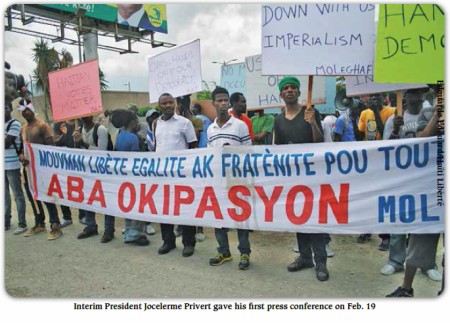
On the day of the protest, the people inside the
U.S. Embassy in Port-au-Prince were protected by a line
of police in riot gear who had nothing to do but stand
there and be hot because they were facing off against
peaceful, unarmed protesters, most wearing jeans and
T-shirts.
The people inside the U.S. Embassy might not have
understood the chants of the protesters because they
were in Kreyòl, but they could read the signs in
English: “Down with Imperialism. Hands Off Our
Democracy. Haitian Votes Matter.”
They will be seeing those signs again.
The
author is a volunteer with the Institute for Justice and
Democracy in Haiti (IJDH). This article was first
published on the Haiti Elections Blog.
|