|
Three years after its
star-studded launch by
President René Préval, actor Sean Penn and various other Haitian
and foreign dignitaries, the
model camp for Haiti’s 2010
earthquake victims has helped give birth to what might become
the country’s most expansive – and most expensive – slum.
Known as “Canaan,” “Jerusalem,” and “ONAville” – the
new shanty-town, spread across 11 square kilometers, is here to
stay, Haitian officials told Haiti Grassroots Watch (HGW).
Taxpayers and foreign donors will likely spend “many hundreds of
millions” to urbanize the region, and as much as another US$64
million to pay off the landowners who are threatening to sue the
government and the humanitarian agencies.
Three years after the launch of the temporary model
camp “Corail-Cesselesse” – located about 18 kilometers northeast
of the capital and named after the nearby habitation
(plantation) that was once home to sugarcane and sisal fields –
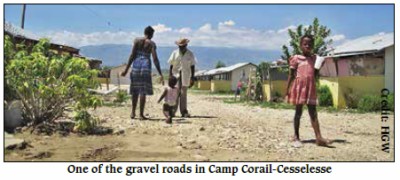
the landscape differs from the orderly camp visited by
celebrities. Surrounded by tens of thousands of squatters’
shacks and homes, today it is a cause of embarrassment for local
and international actors alike.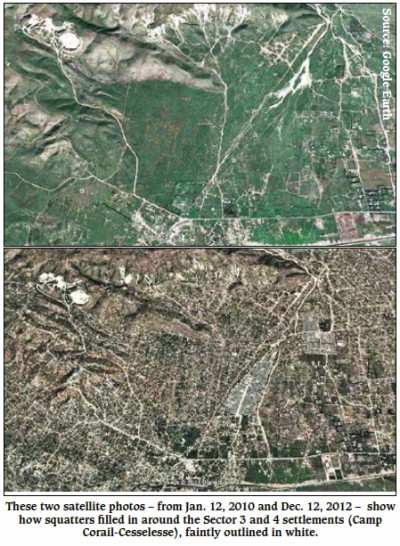
Before the earthquake, most of this arid, rocky
expanse running from the northern outskirts of Port-au-Prince up
to Cabaret was largely empty. Much of it is owned by the Haitian
firm NABATEC, S.A.. Since 1999, the firm had been developing it
into an “integrated economic zone” (IEZ) called “Habitat Haïti
2020” that would have industrial parks, single- and multi-unit
housing for various income levels, schools, green spaces, and a
shopping mall. A Korean company and a U.S.-based humanitarian
group had already purchased land within the perimeter, and
NABATEC was in discussions with a number of foreign firms.
“It was a 15-year, US$2 billion project, and
everyone had already given their approval, including the Haitian
government and the World Bank,” according to architect Gérald
Emile “Aby” Brun, NABATEC’s president and vice president of
TECINA, S.A., a planning and construction firm. A
2011 World Bank study of
potential IEZ sites ranked it best out of 21 possibilities
around the country, calling it potentially “high-performing” and
“the clearest application of the IEZ concept among any proposed
project in Haiti.”
But today, the land – equal to about three Central
Parks – is home to between 65,000 and 100,000 people: 10,000 in
the planned camps and the rest squatters. And they aren’t going
anywhere.
“We can’t move them out,” Haitian government planner
Odnell David told HGW in an exclusive interview. “The idea is to
reorganize the space so that people can live.”
Urbanizing about half of the wasteland will cost
Haitian and foreign taxpayers “many hundreds of millions of
dollars,” noted David, an architect and the director of the
housing section of the government’s Unité de Construction de
Logements et de Bâtiments Publics (UCLBP or Unit for the
Construction of Housing and Public Buildings). The price tag for
initial infrastructure work already tops US$50 million.
Model Camp Leads to Disaster’s Disaster
Opened in April 2010, the Corail “Sector 3” and “Sector 4”
camps together represented the reconstruction’s model
resettlement. They sit on two sloping parcels of 50 square
kilometers of private land declared “of public utility” by the
central government in March 2010. Right from the start, the
choice to move people to the desert-like plain was
controversial, for two reasons. First, some critics accused Brun
and NABATEC of seeking to profit from the disaster, and next,
many said the land under the camps, and indeed much of the
region itself, is not appropriate to any kind of settlement,
temporary or permanent, for environmental and economic reasons.
[See sidebars Capitalizing on Disaster? and
Controversy over Corail Camp.]
Despite the controversies, humanitarian agencies
like the International Organization for Migration (IOM), World
Vision, and the American Refugee Committee (ARC) together spent
over US$10 million to build the two “sectors” – which have
schools, playgrounds, latrines, and some electricity, but which
still lack water. They had planned to build many more camps,
including “Sectors 1 and 2” which sat close by. However, as soon
as the first U.S. Army bulldozers started to level the land,
tens of thousands of people – some but not all of them
earthquake victims – invaded those areas as well as land around
and north of the camps, “buying” parcels from racketeers,
marking off their plots and pitching makeshift tents.
Nobody in the central government said anything to
prevent the land seizures, which continue today. Many say the
land was offered to supporters of Préval’s “Inite” political
party for US$10 per square meter. The new “landowners” got fake
“titles” in exchange for cash and their votes in the upcoming
presidential elections, according to Brun and other sources who
asked not to be named.
“It was an electoral thing,” said Brun.
Planned or not, and political scheme or not, today
those tents have turned into houses built every which way, in
what the UCLBP’s David calls a “savage urbanization… no
infrastructure, no water, no electricity, no sanitation: people
just appropriated land and are trying to accomplish their dreams
of becoming homeowners.”
“The state has a moral obligation to intervene,”
David continued. “You can’t leave it like it is… Those people
are living in difficult conditions.”
Police and local authorities have already set up
offices in tractor-trailer containers.
Life in the camps
Despite the unforgiving sun and its sweltering heat, Joel
Monfiston is working. Hammering a piece of worn plywood to a
battered two-by-four, watering flowers, and picking the weeds
out from between rocks and pebbles.
The 34-year-old father of three crouches in front of
his one-room home in Sector 3. Monfiston and his family first
lived in a tent. Now they have a 24-square-meter “temporary
shelter” built mostly of plywood and sheet metal by World Vision
for US$4,500, according to the agency. Like most Haitians, he
survives with a day job here and there and through help from
friends and family. And, he tries his hand at commerce.
“Things are not easy. Imagine: they put you here,
but there’s no work,” he said.
Monfiston has dreams. He hopes to set up a shop in the little
shed he is building. He would like to grow more in his garden.
But those remain dreams. For now, all he has are a few flowers
and a few walls for his “store”… no shelves, no door, no cooler,
no products.
And, like other Corail residents, while he does have
access to latrines, electricity (solar-powered street lamps),
playgrounds, a clinic, and schools, water is not so easy to
find.
Back in 2011, the UN and Oxfam promised that a new
system of cisterns and kiosks would soon provide residents with
water from the state water agency. Two years later, the faucets
remain dry. Residents buy water at 5 gourdes (about US$0.12) a
bucket from private vendors or from the committees that manage
the few still-functioning water “bladders” left over from the
camp’s early days when water and food were free and when
agencies provided “cash for work” jobs and start-up funds for
would-be entrepreneurs.
Today, all of the big agencies have abandoned the
Corail camp and its 10,000 residents. Trumpeting their success
and claiming to have prepared a “transition” to the local
authorities, IOM, ARC and World Vision all pulled out (although
World Vision still supports the Corail School, which it built).
“Mayor of Croix-des-Bouquets is the New Camp
Manager,” a cheery article from the UN military mission declared
in a May 27, 2011 bulletin. But HGW found no evidence of any
local authorities, or assistance, on two different visits. The
“City Hall Annex” at the Corail camp was shuttered. Residents
told journalists that they could not remember when they last saw
anyone from the government. [See Controversy over Corail Camp.]
“Nobody from the mayor’s office has set foot here
for many months,” said Racide d’Or, a member of the Corail
residents committee. “They were only around when they knew there
was land in the area they could ‘sell,’” continued the mother of
two, who lost her Delmas home in earthquake. “There is no
‘government’ or ‘state’ for those of us who live here. We have
to figure out everything ourselves.”
The Croix-des-Bouquets City Hall annex in Canaan is
sweltering at midday. The “office” is an empty container and a
“conference room” of plywood and a blue plastic tarp roof. Two
men there said they worked for City Hall but refused to give
their names or allow their voices to be recorded.
“They just dumped us here,” said one, aged about 30. “We don’t
have the means to work. Our supervisor never comes to see how we
are doing.”
“I’d like to know what they were thinking when they
put this office here,” said the other one, older, who was
slouched in a plastic chair. “We don’t do anything.”
The absence of humanitarian agencies has one
benefit. When agencies were handing out food, jobs, and cash,
gangs and “mafias” ran various parts of the camps. An Oxfam
program that handed out up to US$1,000 to some – but not all –
small business-people led to disagreements, rumors, protests,
and eventually arrests.
“The NGOs divided us. People fought with each
other,” Auguste Gregory told HGW. Gregory was sitting with
friends next to his telephone-charging business: a table covered
with power strips and chargers. “Some people went to prison.
Others went into hiding. We were all there for the same reason,
but they divided us,” he remembered.
For much of 2010, a gang calling itself “The
Committee of Nine” threatened residents and aid providers alike,
so much so that ARC Camp Manager Richard Poole quit his job and
left the country.
“My three months at Corail were one of the most
difficult periods I have experienced in my 30 years as a
humanitarian worker,” Poole later told HGW in an email
interview. ARC received about US$400,000 to manage the camp for
eight months in 2010.
But, some humanitarian actors say the Corail
settlement was not a complete failure.
“It
is important to look at where the families were at the beginning
of the earthquake and where they are now,” World Vision told HGW
in an email. The agency says it spent about US$7 million on
1,200 shelters, a school, playgrounds, and various programs.
People “came from areas which were prone to flash
flooding, mudslides, and disease outbreaks, but now they are in
a safer and more secure community,” the agency pointed out. “The
families have homes and are protected… We are pleased with these
outcomes.” [See also Controversy over Corail Camp]
Not everyone is pleased
NABATEC president “Aby” Brun is not pleased.
At first, Brun said he and NABATEC hoped the
government and the major reconstruction actors would intervene
to eject the squatters and camp residents, or to at least turn
the camp’s temporary shelters into permanent houses so that they
could become the beginning of Habitat Haïti 2020 [see
Capitalizing on Disaster?].
In the meantime however, Brun deplored the fact that
the Michel Martelly government decided “follow the same abusive
logic” and seize two other pieces of NABATEC land: one at the
corner of Highway #9 and Highway #1 to build a waste treatment
facility on what was slated to be an industrial park, and
another, across the road, to build the offices of the Haitian
Olympic Committee. Those two pieces had been valued by the
government tax office – the Direction Générale des Impôts
(DGI) – at US$10 million, according to Brun.
As months went by, the NABATEC partners – some of
them members of Haiti’s most economically powerful families –
realized their project would no longer be possible.
“The country lost a great opportunity,” Brun said.
“I have been working on that project for 16 years.”
Now, NABATEC wants to be indemnified, according to
the law and the Constitution. The company has submitted
paperwork to the DGI and to each of the three Finance Ministers
who have held office since the “public utility” declaration.
“The last ‘refresher’ meeting was under
Marie-Carmelle Jean-Marie
about three months ago,” Brun said. Jean-Marie resigned in
April, allegedly over differences of opinion concerning a series
of no-bid contracts and other expenditures.
All told, if the government reimburses NABATEC for that land and
the land currently occupied by the camps and the squatters,
NABATEC is due US $64 million.
“We have submitted all the papers and titles,” Brun said in May.
“Verbally, in conversations, they say, ‘Yes, we recognize it’s
your land,’ and they say they are going to pay us, but… nothing
on paper.”
Hoping to confirm Brun’s statements, HGW made almost a dozen
requests for interviews with DGI officials, in writing and in
person, over the course of three months. Finally, in February
2013, Raymond Michel, head of the DGI’s property division,
promised an interview, noting: “This dossier is very, very
sensitive.” Michel never contacted HGW again.
Brun, meanwhile, is growing impatient. NABATEC is open to the
idea of negotiating, but the company is also thinking about
suing both the government and the humanitarian agencies that are
continuing to do projects at Corail or are helping the squatters
in the areas outside the camps, for “infringing on property
owners rights.”
“It’s been three years now,” Brun said. “I understand the
difficulties facing people who don’t have a house, or work, or
schools… but that doesn’t allow for mafia and extortionists to
use people’s distress to make money, and we sit there with
nothing.”
Seeking
funding from, and for, the promised land
While
NABATEC lobbies the Finance Ministry and the DGI for monetary
compensation, another branch of the Haitian government is also
seeking monies, but not to pay the landowners.
Instead, the UCLBP hopes to take NABATEC’s place and build its
own project: the urbanization of about 500 hectares for a
population of 100,000.
According to David, an initial plan is ready, thanks to the
Canadian firm
IBI/DAA and the Haitian
firm SODADE. Asked about the plan and how much it cost, the
architect declined to give the price tag and added that it had
not been put out for bid. Instead, it was tacked onto another
plan already being drawn up by IBI/DAA, which is a frequent
beneficiary of government contracts.
“It is a very perfect plan. It has roads, it has water systems,
it has sanitation,” David added, but he said that HGW could not
see because it had not yet been approved.
Preliminary infrastructure work for a site will cost “about
US$50 million.” But the proto-slum won’t turn into an organized
neighborhood any time soon. Among other challenges, the
residents who have marked out “their” land will have to be
convinced to move to make way for infrastructure.
“It’s a very long term project,” David admitted.
Finding the money will not be easy, either. “We will need a lot
of resources and the state doesn’t have all the funding it would
need… We are seeking financing so that we can at least begin,”
he said. “It won’t happen tomorrow.”
In the meantime, newcomers continue to arrive at the no man’s
land with bundles of belongings, tent stakes, and a few cement
blocks.
Haiti
Grassroots Watch is a partnership of AlterPresse, the Society of
the Animation of Social Communication (SAKS), the Network of
Women Community Radio Broadcasters (REFRAKA), community radio
stations from the Association of Haitian Community Media and
students from the Journalism Laboratory at the State University
of Haiti.
|





