|
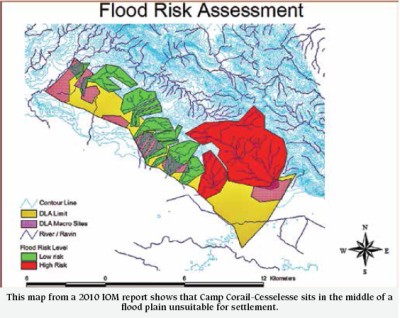
The Corail-Cesselesse camp was set up originally
for about 5,000 displaced people being evacuated from a camp at
a country club (the Pétion-ville Club), which was run by actor
Sean Penn. Many of the refugees lived in tents on dangerously
sloped muddy ground. Penn and some other humanitarian actors
wanted the evacuees to be the first of thousands more who would
be moved out of the city center.
But only three months after the first refugees were installed in
tents – on Jul. 29, 2010 – the UN-linked International
Organization for Migration (IOM)
issued
a report on the entire
“public utility” expanse of land, saying that the area chosen
for Sectors 1 through 4 “is prone to flood and strong wind. As
reported earlier, it is flooded regularly at least once a year.”
“Due to the reoccurrence and magnitude of floods, this site
should not be used for further relocation and resettlement of”
displaced persons, the report concluded.
Nevertheless, World Vision and later IOM itself soon built some
1,500 “transitional shelters” on that very site. Some 10,000
people remain there today and many have invested in their
“shelters,” making them more permanent.
UN-HABITAT disagreed with
the idea of setting up camps on the outskirts of the capital
from the outset, according to Director Jean-Christophe Adrian,
who spoke to HGW in January 2011.
“Corail was created because of pressure from the international
community. The government was opposed to it. Préval was
opposed,” according to Adrian. “This kind of spreading out of
the city isn’t the best thing to do… at the time, it was very
clear: the pressure from the U.S. Army and from our friend Sean
Penn, and support from the international community, made this
turn into a good idea.”
“By declaring the land ‘public utility,’ they opened a Pandora’s
Box,” Adrian added.
World Vision told HGW that
it had not seen the report and that it does not consider the
area high-risk. The agency added that many humanitarian actors
“felt the process was rushed” but that the government had
“determined that the relocation process must begin immediately
and selected Corail as the site for the new community.” World
Vision is currently seeking funding to do a three-year project
of “livelihoods and youth training and development” work with
the camp residents.
The former camp manager from American Refugee Committee was more
direct and less positive.
“ARC did not have a say in the planning of the Corail Camp (and
in fact did not agree with how the things were set up),” Richard
Poole told HGW in an email. While he was not opposed to moving
people out of the capital, he noted that “the location of the
camps far from Port-au-Prince with little or no prospect of
economic activity was a mistake… Without an economic base,
however, the plan was doomed to fail.”
Hélène Mauduit, who works for
Entrepreneurs du monde in
the Corail camp, said that “sure, there are shelters, a
hospital, and a school, but there is no future for the people of
Corail because there is no work, there are no roads, and there’s
no electricity.”
“I think someone should make a decision about Corail,” she
continued. “They either need to destroy it and put people
somewhere else, or they need to say to themselves, ‘Ah, these
are human beings who live at Corail!’ and then need to put into
place everything that can guarantee a normal life. You brought
the people there. You told them there would be work. But nothing
ever happened because the area turned into a slum.”
The former mayor of Croix-des-Bouquets, Jean Saint-Ange Darius,
told HGW that following the earthquake, “local authorities were
ignored and almost all the decisions were made by the central
government… We were not at all involved in the choice of the
site.”
Asked about the Corail camp and surrounding slums
for the Raoul Peck film Assistance Mortelle,
former Interim Haiti Recovery Commission Senior Shelter Advisor
Priscilla Phelps said: “When the story of the Haiti
reconstruction is written, the international community’s going
to be doing a big mea culpa about this site… I hope.” |





