|
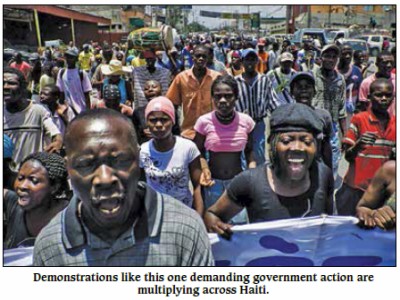
In recent months, demonstrations have
erupted in different parts of Haiti demanding electricity, river
dredging, road and bridge construction, support for farmers, and
the building of schools and hospitals.
The people of Rivière Grise, a
neighborhood located in the capital’s vast slum of Cité Soleil,
demonstrated last week to demand that the river be cleaned of
garbage and debris as the danger of flooding approaches with the
summer hurricane season.
On Jun. 5, residents of the
lower Artibonite Valley blocked National Highway # 1 (which runs
between Port-au-Prince and Haiti’s North) at Pierre-Payen,
Périsse, Carrefour-Peille, Bois-neuf, Liancourt, and Pont-Sondé
to demand electricity, among other things. Demonstrators used
trucks to barricade the road at various points, turning back
vehicles travelling along it.
Meanwhile, one of the five E’s
of President Michel Martelly and Prime Minister Laurent Lamothe
is supposed to be energy. Nevertheless, various parts of the
capital are mostly plunged into darkness. Only five or six hours
of electricity are provided in some places. Lamothe announced at
the beginning of 2013 that within six months, Port-au-Prince
would have electricity 24 hours a day. The government has
clearly not fulfilled this promise, among many others. As the
hurricane season begins, some 320,000 internally displaced
persons (IDPs) remain homeless after the Jan. 12, 2010
earthquake three and a half years ago. This figure includes,
according to the latest count, 166,158 women and 153,893 men
still living in tents in 385 camps scattered around the capital
and its vicinity. Some 22% of IDPs live in 86 camps that are
very vulnerable to natural disasters including floods and
landslides. This also puts them at greater risk for the spread
of diseases such as cholera and H1N1 avian flu. More than three
years after the earthquake, some 73,000 Haitians are threatened
with forced evictions, while some 1.5 million Haitians are
living in food insecurity.
In Parliament’s last two
Finance Laws for Fiscal Years 2011-2012 and 2012-2013, lawmakers
budgeted 10 million gourdes ($231,414) for each of the country's
communes (counties). But with only four months remaining until
the end of fiscal year 2012-2013, these laws have not been
implemented in several municipalities. The executive instead has
used these funds to bargain with and corrupt some unscrupulous
parliamentarians.
When summoned to testify before
the Senate on Jun. 4, Prime Minister Lamothe said that his
government had released about 15 billion gourdes ($347.12
million) after Hurricane Sandy last autumn to solve urgent
problems, almost 13 billion gourdes of it from funds provided by
Venezuela’s PetroCaribe deal.
So although 15 billion gourdes
have been released during the first half of 2013, most peoples’
needs are still not met, and demonstrations are increasing.
Prime Minister Lamothe was unable to present a clear report on
how these disbursed funds have been administered. Senate
President Simon Dieusel Desras stopped a no-confidence vote
against Lamothe’s government on Jun. 4, but, if popular ire
continues to rise, the Senate can be expected to organize
another no-confidence vote soon that will determine the future
of Lamothe’s government. |





