|
by Roger Annis & Kim Ives
 The
plight of some 400,000 Haitians still living under tarps and
tents since the Jan. 12, 2010 earthquake has surged into the
streets and headlines, highlighting one of Haiti’s most
explosive and intractable issues. The
plight of some 400,000 Haitians still living under tarps and
tents since the Jan. 12, 2010 earthquake has surged into the
streets and headlines, highlighting one of Haiti’s most
explosive and intractable issues.
A new
grassroots campaign, an international petition, several new
reports, and street demonstrations have all helped underscore
the problem’s urgency.
On May 31,
dozens of protesters mobilized by the Forces for Reflection and
Action on Housing Matters (FRAKKA) demonstrated in front of the
Prime Minister’s office to denounce the broken promises of
Haitian government officials to provide housing for earthquake
victims.
“We in
FRAKKA have noted the growing speed of forced expulsions against
the displaced people camps,” said Rénel Sanon, FRAKKA’s
Secretary General.
For almost a
year now, the government of President Michel Martelly has
trumpeted a program entitled “16/6,” under which about 30,000
residents of six large camps would be resettled to their
original but repaired 16 neighborhoods, all of which were badly
damaged by the quake. The program has been heavily supported by
foreign governments. To encourage people to leave camps,
residents were told they will receive a one-year rental subsidy
of $500 per family.
But
Alexandre Louissaint, the leader of the camp in the capital’s
Christ-Roi neighborhood, complained that his camp, like many
others, is not covered by the “16/6" program and has been
completely neglected.
“We have
never received any visit, either from the government or from the
NGOs,” Louissaint said. “Martelly’s 16/6 program is a complete
fraud.”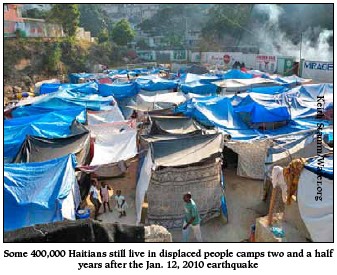
Rénel Sanon
said that camp residents were being terrorized. “Bandits have
set fire to many camps including the Toussaint Louverture camp,
the Place Mosaulée camp, the Mormonts camp, where tents were
burned, and the Eddy François camp at Mon Repos, Carrefour,” he
told Haïti Liberté. “We have also organized this
demonstration to denounce the conduct of Pastor Joel Jeune at
the Grace Village camp in Lamentin 52 and 54. Accompanied by
armed thugs, he continues to persecute the displaced.”
On
Jul. 2, Haitian grassroots organizations, including FRAKKA,
and their international allies launched a housing rights
campaign called
“Under Tents.” It is
demanding permanent housing solutions for the hundreds of
thousands still living in displacement camps around
Port-au-Prince.
The groups are demanding that
the Haitian government immediately halt all forced evictions
until public or affordable housing is made available. They call
on the government, with support from donor countries, to move
quickly to designate land for housing, create one centralized
government housing institution to coordinate and implement a
social housing plan, and solicit and allocate funding to realize
this plan.
Meanwhile, the “Under Tents”
campaign will press for congressional and parliamentary action
in the U.S., Canada, and Europe to support the construction of
housing for displaced Haitians. The campaign will also raise
international awareness about the crisis through news media and
solicit support from housing rights organizations around the
world.
The centerpiece of the campaign
is an
international online petition
demanding that “ the Haitian government address Haiti’s
epidemic of homelessness.” It is addressed to President
Martelly, Haitian Prime Minister Laurent Lamothe, U.S. Secretary
of State Hillary Clinton, her Chief Counselor Cheryl Mills,
Haitian Senate President Simon Dieuseul Desras, and Deputies President Levaillant Louis-Jeune.
The campaign will run through
Oct. 1 and is the initiative of dozens of Haitian grassroots
groups with the support of 14 international organizations
including the Canada Haiti
Action Network (CHAN), Chans Altènativ, Grassroots
International, Haiti Support Group, the Institute for Justice
and Democracy in Haiti (IJDH), Other Worlds, the Quixote Center,
and TransAfrica.
“We are asking simply for
quality homes where people can live," said FRAKKA’s Jackson
Doliscar in announcing the petition and campaign.
Meanwhile,
several new reports on Haitian housing provide a grim picture of
what has and has not been accomplished by international
assistance in the two and a half years since the quake.
A six
page report published in June 2012 by the Jesuit-supported
Port-au-Prince-based Center for Research, Reflection, Training,
and Social Action
(CERFAS) provides some
important statistics.
It says that on the eve of the earthquake, an
estimated 300,000 new lodgings were required. It notes the 2010
post-quake survey commissioned and directed by Haiti’s Public
Works, Transportation and Communication Ministry that showed 20%
of the estimated 414,000 dwellings in the capital were damaged
beyond repair and another 25% were unsafe, requiring structural
repair.
The CERFAS
report shows that housing “reconstruction” efforts have been
directed overwhelmingly to building temporary shelters. CERFAS
estimates that 109,000 of these “t-shelters” (in NGO parlance)
have been erected, compared to 13,000 homes repaired and 5,000
permanent homes built. Temporary shelters have absorbed 79% of
the $461 million spent so far on housing.
Even now,
housing construction is still focussed on building temporary
shelters, with another 5,000 forecast. CERFAS notes critically
that there is nothing “temporary” about the plywood shelters
being built; in the absence of house construction, the
“temporary” shelters are becoming permanent homes, but having
been built to lower standards, they will not last long.
The report
also cites various news reports showing that the beneficiaries
of temporary shelters have often not been Haiti’s most needy.
Some shelters are being sold, while others have ended up on the
rental market.
CERFAS
laments the choice of temporary over permanent housing, echoing
the views of many agencies involved in housing assistance in
Haiti. It notes that a permanent dwelling costs only twice that
of the plywood shelters, and that this difference could be
reduced through economies of scale.
The CERFAS
report looks at the 16/6 program of rental subsidy. It notes
that while the program also provides funding for house repair,
the vast majority of people in the camps, as in the city as a
whole, are renters. The six targeted camps happen to be in the
more well-to-do or conspicuous areas of the city – Place Boyer
and Place St. Pierre in Pétionville, Champ de Mars, Carl
Brouard, Maïs Gaté/Airport, and the Vincent Gymnasium in
Port-au-Prince. The 16/6 beneficiaries amount to about 5% of
those residing in camps, according to the International
Organization for Migration (IOM).
Although the
plan has already evacuated at least three of the camps,
according to the July 2012
Humanitarian
Bulletin of the Office for the Coordination of
Humanitarian Affairs of the UN in Haiti (OCHA), refurbishment
has begun in only eight of the program’s 16 neighborhoods.
According to the IOM, the population in the camps is now just
under 400,000. The reduction is attributed to forced removals,
rent subsidies, and voluntary departures. The drop in the
displaced population is cited by international governments and
media, as well as UN officials, as a sign of progress in
post-earthquake assistance. But the IOM admits that beyond the
“16/6" camps, it “doesn’t
know” where the disappeared numbers have gone
or if their new conditions are better than camp conditions.
Many of the departures no doubt
account for the high re-occupation rates of damaged or destroyed
houses.
Forced
relocations remain a threat to displaced persons in the camps,
and even people targeted by “16/6" program have been victimized.
CERFAS reports that in April 2012, 81,000 camp residents were
threatened with eviction.
CERFAS cites
Article 11 of the 1976
International Covenant on Economic, Social and Cultural Rights,
which reads, “The States Parties to the present Covenant
recognize the right of everyone to an adequate standard of
living for himself and his family, including adequate food,
clothing and housing, and to the continuous improvement of
living conditions. The States Parties will take appropriate
steps to ensure the realization of this right, recognizing to
this effect the essential importance of international
co-operation based on free consent.”
CERFAS also
cites Article 22 of Haiti’s Constitution which guarantees the
right to housing and obliges the Haitian government to ensure
it.
Shortly
following the earthquake, the Haitian government adopted an
“Action Plan” for reconstruction, affirming that the “absolute
priority…is to respond to the needs of the affected population,”
notably with respect to temporary and permanent housing needs.
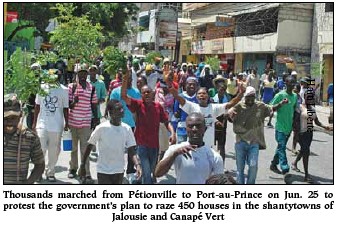
As
calls to build housing grow, the government announced it would
raze about 450 homes in the hillside shantytowns of Jalousie and
Canapé Vert in order to prevent more environmental damage to
Morne L’Hôpital, the mountain that towers over Port-au-Prince’s
south-eastern flank. In compensation, the government is offering
family’s losing their home a mere 100,000 gourdes ($2,500).
The announcement provoked large
anti-Martelly marches through the streets of Pétionville on Jun.
21 and 25. The latter demonstration, which numbered over 2,000
people, marched all the way down to the Champ de Mars public
square in front of the National Palace.
Housing protests are coinciding
with other rising demands. The Jun. 25 Champ de Mars rally was
joined by small merchants from the large, informal market at the
Port-au-Prince port which burned to the ground on Jun. 18.
Merchants have received no assistance or compensation from the
government.
“Several days ago we were
victim of a serious fire,” one small merchant told Haiti
Liberté. “No government authority has come to speak to us.
They are intending to abandon us, just as happened to the
merchants at Tabarre [a fire burned that market to the ground in
February]. But we’re here to send a message to those responsible
for the country that if they do nothing for the small merchants,
we will take action.”
Haiti Liberté has also reported that
residents in several regions of Haiti, including Cabaret, north
of the capital, and Miragoâne and Petit Goâve to the south,
staged militant protests in June to demand that local
authorities act to improve and stabilize electrical service. |





