|
Working together with a local official, two humanitarian
institutions have – unwittingly or not – contributed to the
deforestation of part of Morne l’Hôpital, a mountain that
overlooks the capital and which is under special environmental
protection.
An
investigation by Haiti Grassroots Watch (HGW) in the Upper
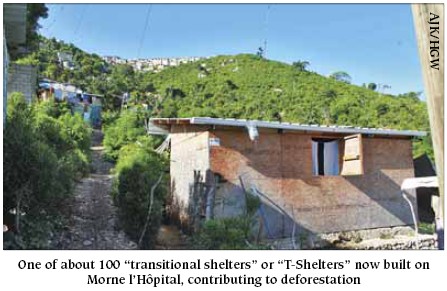
Turgeau region of Port-au-Prince discovered that about 100
“transitional shelters” – often called “T-Shelters” – were
donated to earthquake victims and built in places where, prior
to the 2010 catastrophe, there were trees, bushes, or at the
very least, no houses. Today, thanks to the donations of the
12-by-18 square meter wooden shacks, an illegal slum has grown,
and the slopes above Port-au-Prince are even more denuded.
Humanitarian organizations Agency for Assistance in Development
and Technical Cooperation or ACTED (in French: the Agence
pour la coopération technique et au développement) and GOAL
assisted at least 100 displaced families by constructing little
houses in green spaces in the protected area. The mountain slope
– which cuts through parts of Pétion-ville, Port-au-Prince, and
Carrefour – is covered by a 1963 law and a 1986 decree which
stipulate that the slope should be specially protected.
One
of the institutions – GOAL – was funded by the US government for
the project. The other – ACTED – by the American Red Cross.
[ACTED is also supported by the Clinton Foundation - HL].
The
laws set forth a whole series of rules regarding what is
permitted, and what is not, on the slope. The government agency
Organism for the Oversight and Planning for Morne l’Hôpital or
OSAMH (in French: Organisme de Surveillance et d’Aménagement
du Morne l’Hôpital) is tasked with overseeing the protected
zone.
Nevertheless, the two non-governmental organizations (NGOs), who
both admit knowing about the protected status of the region,
built T-Shelters there, in part thanks to assistance from the
president of the Turgeau Communal Council Board (CASEC),
engineer Raoul Pierre-Louis.
(In
Haiti, each “commune” – a subdivision of the “department” or
province, is divided into “communal sections.” According to the
1986 Constitution, each communal section is supposed to have an
assembly – like a mini-parliament – and an executive committee
or board of three. The assemblies have rarely functioned, and
so, in many instances, the executive council is chosen by the
central government or elected directly. Pierre-Louis was
elected, but like all other CASECs and mayors, his term has
expired.)
“Because of the destruction of homes caused by the earthquake,
we needed to see how, temporarily, we could find a way to
rehouse people,” said Fredly Anténor, coordinator of the
construction team for the Irish NGO GOAL.
ACTED
and GOAL are just two of the many NGOs that built T-Shelters to
help families leave the sordid refugee camps set up after the
earthquake. Despite the fact that many actors criticized the
focus on T-Shelters as a response to the emergency situation
created by the 1.3 million displaced people, several dozen
humanitarian institutions built over 110,000 of the little
supposedly temporary houses for a total cost of US$500 million.
Over
at ACTED, Marianna Franco, head of the development program which
built 28 T-Shelters on Morne L’Hôpital, gave much the same
explanation: “When the idea for T-Shelters came along, there
wasn’t any kind of urban development plan for Port-au-Prince or
the metropolitan area. There still isn’t! So, we built
T-Shelters where we could find space.”
According to Franco, her agency worked with the CASEC and made
sure that all T-Shelter beneficiaries had property titles.
However, according to CASEC president Pierre-Louis, ACTED did
not follow correct procedures.
The “weak
state” in plain view
A law – published
in the official government journal Le Moniteur on
November 6, 1986, is very clear about Morne L’Hôpital:
“Residential construction is not permitted unless permission is
obtained from the relevant agencies” [Article 9] and “It is not
permitted to graze cows or goats; to cut any wood or bush, to
undertake any kind of planting that involves hoeing… or do any
kind of burning for whatever reason.” [Article 11]
But
plots were cleared, trees cut, and foundations prepared for at
least 100 of the new little houses, and probably more.
The
director of OSAMH, agronomist Montus Michel, recognizes that his
agency is weak. He lacks the necessary human resources,
financial resources, and also authority in the field.
“The
state can’t really intervene [at Morne l’Hôpital] without the
accompaniment of the police and representatives of the justice
system. It’s written in the law. When OSAMH wants to go into the
field, its agents should be escorted by someone from the legal
system,” he said.
While
the law might state that imperative, the reality is different.
Agents work on their own.
“As
far as surveillance and control of activities at Morne l’Hôpital
go, and as far as protecting the ecosystem goes, OSAMH is very
weak, but this is due also to the general weakness of the
state,” Michel admitted.
A
sign of that “weakness?”
GOAL
said it did indeed know that the region was protected, and that
the agency OSAMH was responsible for overseeing it. GOAL
representatives also said that they met with an OSAMH agent.
“We
worked with OSAMH starting from the beginning. OSAMH is the one
that gave us the geographic limits of where we could build,”
Fredly remembered, and one of his colleagues added that the
agent’s name was Canez Dellande.
OSAMH
director Michel rejected the statement. “GOAL?” he asked. “That
is a total lie.”
“We
never delegated anyone to work with them. We could never send an
engineer out to set the limits if the NGO didn’t first give us a
plan that outlined their activity… Canez doesn’t have the right
to do that kind of work, to meet with representatives of an NGO
in order to allow them to work on Morne l’Hôpital. That
relationship is supposed to be institution to institution,” the
director said.
But
Michel also recognized that his agent never told him about the
initiative.
In
the meantime, it appears that the NGO ACTED worked on its own,
because Michel said he never met with any representative of that
institution either.
Another state
institution…
In addition to
reportedly working with an OSAMH agent, GOAL representatives
said they collaborated closely with CASEC president
Pierre-Louis, who is in fact another representative of the
state.
“We
built a total of 2,483 T-Shelters [in the 6th
communal section of Turgeau],” Pierre-Louis said. “There is a
signed document for all the shelters that GOAL built. The same
goes for CORDAID and IOM [two other organizations that built
T-Shelters in Turgeau].”
“All
of the Upper Turgeau T-Shelters were built with the permission
of the CASEC,” GOAL country director Derek Butler confirmed.
And,
according to both Butler and Pierre-Louis, all the T-Shelters
were built in spots that held houses before.
But
HGW investigations revealed the contrary. At least 100 little
homes were built in places that previously before had no
construction.
When
confronted with this truth, Pierre-Louis rejected the statement,
and then added, “in any case, they are temporary. They need to
be moved.”
But
that seems unlikely.
From temporary
to permanent
All over the
country in the earthquake-affected zones, T-Shelter recipients
are busy converting the shacks into permanent homes with
concrete walls, extra rooms and other additions.
When
questioned, GOAL said it was aware of the phenomenon.
“When
you build a temporary shelter for someone, it is very likely
that it will become permanent. We have seen people doing the
transformation,” a GOAL agent admitted to Pierre-Louis during a
telephone call for which HGW was present. “Therefore, we said to
ourselves, ‘Let’s see how we can help these people turn their
temporary shelters into permanent homes.’”
In an
interview with HGW, ACTED said much the same.
Pierre-Louis was visibly displeased.
“We
signed papers that say ‘shelter’ not ‘house,’” he told HGW. “We
have a land ownership problem. That land does not belong to the
displaced people. You cannot build a permanent home in a place
that does not belong to you.”
Who has the
power to protect and to decide?
When it comes to
the case of the T-Shelters built in formerly green spaces on
Morne l’Hôpital, it is clear that two state authorities – CASEC
president Pierre-Louis and OSAMH – failed in their mission to
respect and assure respect for the law.
But,
there is also another authority implicated in the expansion of
the slum on Morne l’Hôpital.
The
GOAL T-Shelters were built with money from the US government,
from the Office of US Foreign Disaster Assistance (OFDA).
Parallel to that grant, however, and ironically, immediately
after the earthquake another agency – the US Agency for
International Development (USAID) – published a document
announcing that the catastrophe had created an opportunity to
protect the zone.
“The
steeply sloped Morne l’Hôpital benefits, at least theoretically,
from its special legal status as a ‘public utility,’ a protected
area off limits to construction,” notes the document, which also
says USAID partners with OSAMH. “The post-earthquake period
provides an unprecedented opportunity to assert control over
Morne l’Hôpital as a legally protected zone and prevent new
housing construction on fragile slopes.”
HGW
requested, without success, an interview with USAID’s Haiti
office in order to better understand why one US agency financed
the deforestation of Morne l’Hôpital while another suggested the
exact opposite.
HGW
also wrote to the USAID supervisory office in El Salvador, but
received no response.
OSAMH
director Michel does not deny the responsibility of the
government in the expanding slumification, or in the continued
construction of the homes by the well-to-do in the protected
area. But the agronomist also feels that certain NGOs are
irresponsible.
“We
can’t stop the NGOs from doing work inside the 2,000 hectares…
But they should follow the law and meet with OSAMH to see how
things out to be done,” Michel said. “Because, if we let NGOs
come, independent of OSAMH, and help increase the slums on Morne
l’Hôpital, well, that is very bad for the country.”
As
for Pierre-Louis, he said, cynically: “The slumification of
Port-au-Prince has just started.”
“The
problem isn’t the slums, but it’s when the slums stay slums for
too long,” he added. Pierre-Louis sees slums as a natural phase
in “the process of urbanization.”
Kettie
Guerrier and Milo Milfort for Haiti Grassroots Watch
http://www.haitigrassrootswatch.org
This report made possible with
the support of the Fund for Investigative Journalism in Haiti
http://fijhaitienglish.blogspot.com/
Haiti Grassroots Watch is a partnership of AlterPresse, the
Society of the Animation of Social Communication (SAKS), the
Network of Women Community Radio Broadcasters (REFRAKA),
community radio stations from the Association of Haitian
Community Media and students from the Journalism Laboratory at
the State University of Haiti. |





