|
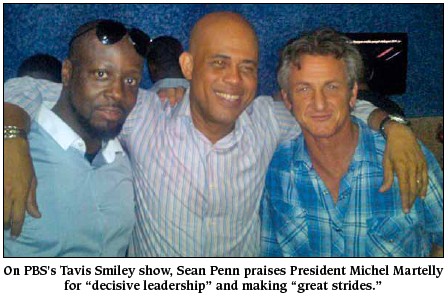
Last week, the PBS television interview program
Tavis Smiley featured two half-hour evenings with
Hollywood actor Sean Penn, a leading force in humanitarian
relief work in Haiti since the Jan. 12, 2010 earthquake.
Mr.
Penn, subtitled by the program as an “Actor/Humanitarian,”
strongly defended the new neocolonial order established in Haiti
through the foreign-sponsored exclusion election of 2010/11 and
the foreign-led, post-quake “reconstruction” plan
spearheaded by Bill Clinton.
Mr. Penn made no mention of the foreign military
occupation force increasingly denounced by Haitians, the United
Nations Mission to Stabilize Haiti (MINUSTAH). (Just this week,
UN soldiers in Port-au-Prince and Gonaïves were once again
accused of sexual abuse of Haitian minors, a recurring
phenomenon for which none have been brought to justice.)
Most notable was Mr. Penn’s strong praise for Haitian
President Michel Martelly, whom he lauded for
“decisive leadership” and
making “great
strides,” although he never named any Martelly programs that
so impressed him.
“For us that
were there on the ground, it was really clear that [Martelly]
was the candidate that [the Haitian people] were looking to have
be their president,” Penn asserted, saying that the population
enjoyed an “enormous morale boost in a kind of historical
(sic)
way when they were able to challenge
the status quo” by electing
Martelly.
It apparently
does not trouble Mr. Penn that
less than 25% of the
Haitian electorate took part in the vote. Many Haitians shunned
the foreign-imposed, fraud-filled and violence-marred “selection”
that excluded the Fanmi Lavalas party of former President
Jean-Bertrand Aristide, as all elections have done since the
2004 coup d’etat against him.
Mr. Penn also
defended the Organization of American States (OAS) after it
brazenly and shamelessly meddled in Haiti’s sovereign electoral
process to bump out of the second round
the candidate of former
President René Préval’s party in favor of Martelly. Mr. Penn
called the OAS’s take-over of the election a “look-over”
and applauded U.S. and OAS threats against Haiti’s government
and electoral council as benignly “able to ultimately
influence what I think was the legitimate inclusion of candidate
Martelly who then became President Martelly.” (The Cuban
government accurately dubs the OAS Washington’s “Ministry of
Colonial Affairs.”)
It would truly be “historic” if the U.S.
contributed to promoting democracy and “challenging the
status quo” in Latin America, but this is hardly what took
place.
Most shockingly, Penn called for “reconciliation”
with former dictator Jean-Claude “Baby Doc” Duvalier, who
returned to Haiti last January. Haitian citizens and human
rights groups are working earnestly to have the former tyrant
placed on trial for crimes against humanity and embezzling
hundreds of millions of dollars from the Haitian treasury during
his 15 year reign.
Today, Mr. Penn said, “there is a sense of truth
and reconciliation that is not formalized but it is understood
and accepted.” He went further in saying, “there is an
inherent loyalty in Haiti society that forgives a lot… It’s
really not for us, Americans, to make that judgement about
whether a culture is willing to reintegrate people.”
Mr. Penn infers this forgiveness because, in a posh Pétionville restaurant recently, he saw that Duvalier was not “accosted”
by patrons while the former “President for Life” dined.
Could the composition of the bourgeois restaurant’s clientele or
Duvalier’s impressive security detail have anything to do with
the lack of flack he receives during his regular but
unauthorized outings from supposed house arrest imposed by an
investigating judge one year ago? (Last week, the judge warned
Duvalier about his brazen disregard of the court limitations
placed on his movements.)
Program host Tavis Smiley, to his credit, did not
want “to put Duvalier and
Aristide in the same sentence”
because “one
is a dictator, the other is democratically elected.”
But then he proceeded to liken them, saying “both of them get
run out of the country…With regard to Aristide, depending where
one comes down, he is run out by the Haitian people or he is run
out and escorted out by the U.S. government.” One would have
hoped for a little less agnosticism from Tavis Smiley, who has
been speaking across the U.S. with progressive professor Cornell
West.
In response, Mr. Penn argued that
“as for a political threat, I think
it’s very understood that Duvalier represents none,” later
specifying that “as a presidential candidate [he] does not
pose a threat,” as if that were ever in question.
Perhaps the best reply to Mr. Penn comes from a Jan. 23 open
letter to President Martelly by about two dozen Duvalier regime
victims and Haitian human rights groups who “note with
concern and indignation, after one year, Jean-Claude Duvalier is
not worried at all, even though he is being prosecuted by the
state and complaints from victims. The co-authors and
accomplices of his crimes are not worried. The case has not
progressed satisfactorily in terms of the need for justice. We
object in the most formal manner against this tendency to
banalize his dictatorship and disregard the legitimate claims
for justice by people who have suffered and continue to suffer
in silence in the face of the arrogance and threats of those for
whom the law is just a joke... Mr. President, the state
authorities cannot continue to play Pontius Pilate.”
Meanwhile, with regard to Aristide, Mr. Penn said he
hopes the former president “will have a productive
contribution to make outside of politics” [author’s
emphasis].
“In Haiti, he’s
a little bit history,” said
Mr. Penn of Aristide, echoing many U.S. State Department
statements. He then
back-tracked a little saying
Aristide “has an influence” and his Lavalas Party “a
particularly strong influence in Haiti.”
But then he
quickly turned the interview back to President Martelly,
who he praised
for “quick learning,” and for being “extremely
shrewd and just practical”
in dealing with the
former presidents.
“Haiti is not
the kind of country that can afford to do the kind of righteous
accountability that we have a high responsibility to in our own
government, and one that we very rarely fulfill,” Mr. Penn
said.
In the interview’s second instalment, Mr. Penn effusively
praised Bill Clinton
as “without a doubt the most
significant foreign player in Haiti”
who is “the
great hope of partners of Haiti.”
“When people are
critical of President Clinton in this, I think what they have to
understand is that most of the billions of dollars that were
raised, that they complain has not yet been spent, would not
have been in existence if President Clinton had not been there
to encourage raising those funds,” Mr. Penn argued.
At the same time, the actor boldly and accurately
asserted that “Haiti would have been better off today had
there never been a single NGO there in these last 30 years,”
that the NGOs have been “a primarily destructive force.”
Unfortunately, Mr. Penn is as smitten with Clinton
as he is with Martelly. So he concludes that NGOs are now doing
a good job and “beginning to align in a way” that is
effective
“largely because of
the leadership of President Clinton.” In short, Clinton and
his deputy Cheryl Mills have reformed the NGO world and
contributed mightily to the “miracle of what has happened in
only two years.”
Mr. Penn’s pro-U.S. and pro-Martelly positions will
not surprise those who read his lengthy response to Janet
Reitman’s devastating exposé of the NGO community in Rolling
Stone last September. In that letter to the magazine, the
indisputably talented actor explains how he had to adopt an
anti-“rich guy” posture when addressing “a group of
pro-Aristide, anti-foreign ‘community leaders’” in the IDP
camp he helped set up on the grounds of Haiti’s sole country
club.
He also called Duvalier’s January 2011 return “anti-climactic”
and a “distraction,” much like Aristide’s “inflammatory”
March 2011 return.
Mr. Penn lashed out at Reitman for “dismiss[ing]
Martelly as a right-wing militarist in the pocket of the private
sector and the United States government,” which is “an
assertion entrenched in the lust for endless struggle and the
imposition of American norms with no practical regard for a
Haitian context.”
He also supports Martelly’s push for “a new
Haitian military” (in reality, a resurrection of the old
coup-making army) because it will supposedly replace the “foreign
faces, helmets, weapons and APCs of United Nations peacekeepers,”
although he salutes their “exceptional work.” (A study
last year prepared by Robert Muggah, a director of the Small
Arms Survey, and others reported near-universal opposition among
Haitians to Martelly’s planned army.)
Mr. Penn then denounces Haiti’s parliamentarians for their “sabotage techniques”
(i.e. opposition to Martelly’s first two ultra-conservative PM
nominees), charging they are “glued together by the threat
tactics of a former Fanmi Lavalas party president, whose
untimely return was principally facilitated and encouraged by
forces outside of Haiti.” (Apparently, Mr. Penn did not read
Haïti Liberté’s
WikiLeaks-based articles
on how the U.S., France, Canada and the Vatican all sought to
thwart Aristide’s return and how thousands of Haitians turned
out to greet him.)
Mr. Penn rails against the Lavalas “demagogues”
and their call for “romantic reparations over tangible repair”
and the fact that they “so vilify the families of the
bourgeoisie that the human construct of progress has been
reduced to a protectionist pissing contest.”
Sadly, Mr. Penn appears to be lending his progressive
credentials (which include commendable support for the
governments of Cuba and Venezuela) to bolster a rightist,
demagogic critique against NGOs made by Martelly, his entourage,
and his international celebrity supporters, including the former
Governor General of Canada, Michaëlle
Jean (see this author’s
story on the latter on
Rabble.ca).
The right-wing’s critique of NGOs is distinguished
by how it ignores and covers up any explanation of the origin of
the “Republic of NGOs” in Haiti. Penn et al treat the
NGOs alone as the problem and conveniently ignore the
political masters behind the scenes. “Suspicion and
cynicism toward U.S. policy in Haiti have shameful historic
validity, but it is a new day,” Penn concluded in his letter
to the Rolling Stone.
It is no accident that the NGOs have become so prominent in
Haiti. They have been deliberately used by the imperial powers
to weaken and undermine the political sovereignty of the Haitian
people. They have been financed and promoted to deliver
services, replacing a role that properly belongs to the
sovereign government.
The true allies of the Haitian people, including many
international organizations and NGOs, are those who recognize
the nefarious intervention of imperialism for what it is and act
to counter it in words or in deeds. Sean Penn, regretfully,
lends his celebrity and humanitarian spirit to the wrong side of
this equation during this crucial chapter in Haiti’s history. |





