|
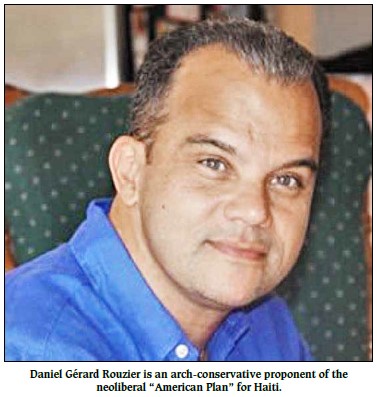 On the eve of President-elect Joseph
Michel Martelly’s inauguration
on May 14, it was leaked – but
not confirmed or denied by the Martelly
team – that the new president
next week would likely nominate (for
Parliament’s approval) businessman
Daniel Gérard Rouzier as Prime Minister,
Haiti’s most powerful executive
post. On the eve of President-elect Joseph
Michel Martelly’s inauguration
on May 14, it was leaked – but
not confirmed or denied by the Martelly
team – that the new president
next week would likely nominate (for
Parliament’s approval) businessman
Daniel Gérard Rouzier as Prime Minister,
Haiti’s most powerful executive
post. Like President-elect Martelly,
Rouzier is an arch-conservative, a
supporter of the 2004 coup d’état
against former President Jean-Bertrand
Aristide, and a devotee of neoliberal
economics. Rouzier is a classic example of
Haiti’s comprador bourgeoisie as the
founder and general manager of Sun
Auto, Haiti’s largest car dealership. In addition he is the chairman
of E-Power, an independent 30 megawatt
electrical power plant launched
in January in the Bois Neuf area of
Cité Soleil. The $59.5 million plant,
largely financed by the World Bank’s
International Finance Corporation
(IFC), runs on Heavy Fuel Oil diesel,
which is less expensive than the Light
Fuel Oil diesel that powers the nearby
Varreux power station belonging
to the state-owned Electricité d’Haïti
(EDH). Rouzier is also vice-president of
the Haitian chapter of Christian behemoth
Food for the Poor, the third
largest international relief and development
charity in the U.S., and the
author of two books: Vision ou Illusion
(2000) and Le Pouvoir des Idées
(2002). He also sits on the board of the
Haitian investment bank PromoCapital
and the Haitian Finance Company
for Development (SOFIHDES) as well
as the American Chamber of Commerce
in Haiti. An ostensibly deeply religious
Catholic, Rouzier sponsored a Haitian
bishop and an American priest to
bless the unmarked mass-grave sites
of some 2,500 Haitian earthquake
victims dumped near Titayen, just
north of the capital, Port-au-Prince. “I was just appalled,” Rouzier
said according to a YouTube video
he helped produce about his efforts.
“This was sacrilege.” The video says
that he turned his Sun Auto body
shop into a foundry to make steel
crosses for the earthquake dead. “He’s very
conservative,” says Bobby Duval, who runs a celebrated
soccer training camp for kids from Haiti’s slums. “He’s
definitely right-wing, but very smart rightwing. Those are the
more dangerous.” Daniel Rouzier, who was educated
at Dartmouth and Georgetown
universities in the States, is the son
of Gérard Raoul Rouzier, the Minister
of Sports for dictator Jean-Claude
Duvalier in the 1970s. “We used to
call his father Ayatollah Rouzier,”
said Duval, a former soccer star who
spent almost a year and a half in one
of Duvalier’s most infamous prisons,
Fort Dimanche. An inkling of Rouzier's political bent
can be gleaned from an article he
wrote in March 2004 for The Nassau
Institute, a Bahamas-based Milton
Friedman-inspired think-tank “that
promotes capitalism and free markets,”
according to its website. “I have also followed the indignation
and general outcry of CARICOM
leaders who are mistakenly
jumping to conclusions while being
greatly misinformed about Haiti’s
situation,” Rouzier writes of CARICOM’s
protest against the Feb. 29,
2004 coup d’état where U.S. Special
Forces kidnapped Aristide from his
home and exiled him to Africa. “Of an
even greater concern to many of us is
that our former president [Aristide]
would come back so soon, as a CARICOM
hero, to our Caribbean waters.”
Here Rouzier echoes the arrogant
warnings issued by U.S. National Security
advisor Condoleeza Rice and
Defense Secretary Donald Rumsfeld
that Aristide should “stay out of the
hemisphere.” In his article, Rouzier goes on to
call Aristide “one of the most violent
rulers Haiti ever had,” speculating that “his only intent seems to have
only been to replace the dictators that preceded him rather than
to promote real change in Haiti.” Having supported the coup,
Rouzier astonishingly writes that “we need institutions that will enforce the
rule of law,” while charging that “Haitian demagogues
(not the least being Aristide) have killed hope.” Rouzier then lays out his vision
for Haiti. “In order for Haiti to
be stable it must be prosperous and
vice versa. Stability can only come
through institution building. Prosperity,
on the other hand, will only
come with the infusion of fresh capital.” To achieve this he lays out how
the “private sector [should] be the proponent of a development strategy”
based among other things on “establishing a free trade/free
port regime with zero import tariffs” and “privatizing public
enterprises,” like
EDH, which is now E-Power’s main
competitor and one of the last publicly-
owned Haitian enterprises. Rouzier closes by toasting the
U.S., French and Canadian troops that
militarily occupied Haiti right after the
2004 coup. “US forces have landed
but they can no longer afford to
window-dress,” he writes. “They will
have to help us consolidate our democratic
institutions and establish the
rule of law. The US, Canada, France
and our other friends will need to
come up with aggressive initiatives
to help us attract foreign capital...
Our economic policy must however
remain sharply focused on the priorities
defined to attract foreign investments
and satisfy the criteria of
the World Bank and the IMF... I am
grateful for the new opportunities
that we are being afforded. I believe
that the French and American troops
that are on Haitian soil today are
different from those of 1803 [when
France colonized Haiti] and 1915
[when U.S. Marines neo-colonized
it]. If once again foreign troops had
to come to Haiti, the problem is with
us Haitians, not with them.” It is hard to imagine a purer articulation
of the Haitian bourgeoisie’s
subservient vision. Nonetheless, Martelly may face
a fight if Rouzier is his nominee. The
Prime Minister must come from the
ranks of the majority party in the Parliament.
Unity, the party of outgoing
President René Préval, presently
holds 17 of 30 Senate seats and 46
of 99 Deputy seats. Sen. Joseph Lambert,
Unity’s coordinator, responded
to word of Rouzier’s eventual nomination
by saying on Radio Métropole
on May 6: “I recall for Mr. Micky
who, maybe, has not mastered the
different articles of the Constitution
or the Constitution in its entirety
that he must stop acting like an elephant
in a china shop... I say to
him immediately that the Parliament
is not a show where one does
just anything.” This stand-off is the principal
reason why Martelly, along with the
U.S. and its proxies in the OAS and
CARICOM, are calling for review of
17 Deputy races and two Senate races.
As we go to press, the National
Electoral Complaints and Challenges
Bureau (BCEN) has handed down a
ruling supporting the U.S. call for the
19 races to be revisited. Rouzier clearly would be a
Prime Minister who would privatize
Haiti’s last remaining state enterprises
“as the basis for foreign capital to
start flowing into the country” and
slash all tariff walls to “establish a level playing field,”
eliminate “undue governmental control or interference,”
and “come up with aggressive initiatives to help us attract foreign
capital,”
as he has written. In short, he would rev up the “American Plan” which Washington has been forcing
on the Haitian people since 1986. |


