|
Le ministre de l’Intérieur, Paul Antoine Bien-Aimé, a été urgemment
dépêché sur les lieux pour constater les dégâts
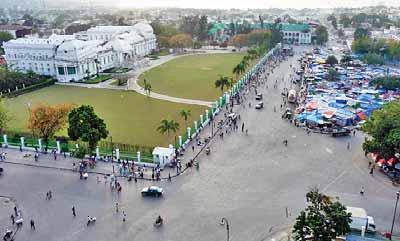
The Champ de Mars, Port-au-
Prince’s central park, is a giant
patchwork of sheets, tarpaulins, and
tents. In the week after the quake,
estimates were that some 50,000
displaced people lived there. Now
the offi cial fi gure has been recalibrated
down to around 10,000.
Some people may have left it, but
the vast majority have stayed. In
its six weeks of existence, the giant
refugee camp has taken on the
feel of a small town, albeit a densely
packed one.
Alex Joseph, 15, is part of
a collective of artists just west of
Grande Rue. The Grande Rue artists,
as they are known, create
“astonishing post-apocalyptic constructions
out of the cast-off refuse
of Western civilization, mixing
chunks of carved wood and human
skulls with abandoned car parts,
circuit boards, television housings
and whatever other bits of mechanical
detritus they can get their
hands on,” wrote journalist Richard
Fleming. In December 2009, artists
from around the world converged
on the Grande Rue artists’ open air
workspace and gallery, with its corrugated-
tin walls, for the fi rst Ghetto
Biennale, a three-week celebration
and convergence of world and Haitian
art. Alex and his fellow artists
were the toast of the world’s avantgarde
art community and on their
way to growing global renown.
Then the earthquake struck.
Grande Rue, the spinal cord of the
capital, was the city’s most devastated
sector. Miraculously, most of
the workspace, artwork and artists
survived. However, today Alex
lives with another teenage friend in
a make-shift tent on the Champ de
Mars.
He leads us on a tour of the
impromptu settlement, pulling back
the sheets that serve as doors to
show us, here, a mother tending to
a scampering brood, there, an old
lady with tooth-pick arms and hollow
eyes lying on a rickety cot. In
the narrow pathways between tents
– the equivalent of the “kòridò”, or
alleys, of the slums – young girls fi x
each others’ hair, boys bath out of
plastic buckets and old men sit sideways
on fl imsy chairs surveying everything
and nothing in particular.
At the Champ de Mars’ southwest
entrance is a small windowless
concrete bunker that houses the offi
ce – really just a bare cinder-block
room – for the park’s security and
maintenance crew. Junior Mercifrères,
35, an earnest and intense
man with dread locks, has pitched
his tent on the steps just behind the
bunker. He lives in it with his wife
and two young children. He was
able to snag this choice spot because
he is one of the park’s guardians.
Now Junior lives exactly seven
paces from his “offi ce.”
On his tent, under plastic, is
taped a large picture of former Haitian
President Jean-Bertrand Aristide,
who remains in exile in South
Africa almost six years after the Feb.
29, 2004 U.S.-backed coup d’état
that deposed him.
“After God, it’s Aristide who
guides us,” Junior explains. He talks
about the demonstration held in
front of the crumpled National Palace
on Feb. 17 when French President
Nicolas Sarkozy visited Haiti
for a few hours. Several hundred
demonstrators called for Sarkozy to
honor Aristide’s 2003 request that
France restitute Haiti $21.7 billion
for the 90 million gold francs France
extorted from Haiti between 1825
to 1947. Instead, Sarkozy offered
about $447 million in aid and debt
cancellation. His gesture didn’t appease
Junior. |

